
"Restoring the Structure and Function of Your Nose."
A septal perforation-a hole in the nasal septum-is more than just a nuisance. It causes chronic crusting, nosebleeds, whistling when you breathe, and a collapsed, "saddle-nose" deformity. Many doctors consider this condition difficult to fix, but reconstruction is possible.
Why Repair is Difficult (And Why You Need a Specialist)
Closing a hole in the septum is one of the most challenging surgeries in otolaryngology.
- Poor Blood Supply: The tissue in the center of the septum has very little blood flow, making healing difficult.
- Tension: Simply sewing the edges together usually fails because the tension pulls the wound apart.
- Scarring: Previous attempts or trauma leave scar tissue that must be navigated carefully.
This is not a procedure for a generalist. It requires a dual-expertise in Sinus Surgery and Facial Plastic Surgery to successfully close the hole while maintaining the external shape of the nose.
The Yeung Institute Approach
Dr. Cecil Yeung utilizes advanced reconstructive techniques typically reserved for complex trauma cases. Our Surgical Strategy:
- Flap Reconstruction: We do not just use tissue grafts. We use advanced flap techniques (rotating healthy tissue with a good blood supply) to ensure the hole stays closed.
- Connective Tissue Grafts: We often use temporalis fascia (from the side of the head) or other biologic materials to provide a robust scaffold for new tissue growth.
- External Rhinoplasty Approach: For large perforations, we may use an external approach to fully visualize the defect, ensuring precise closure.
- Aesthetic Preservation: As a Fellow of the American Academy of Facial Plastic Surgery, Dr. Yeung ensures that while he fixes the internal function, he simultaneously preserves or improves the external appearance of your nose.
Symptoms We Treat
If you are experiencing any of the following, you may have a septal perforation that requires repair:
- Persistent whistling noise when breathing.
- Frequent nosebleeds (epistaxis).
- Nasal crusting or dryness that requires daily picking/cleaning.
- A feeling of nasal collapse or obstructed airflow.
- History of previous nasal surgery or cocaine use.
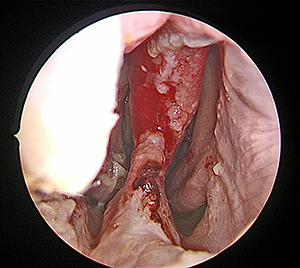
1. Perforation as presented
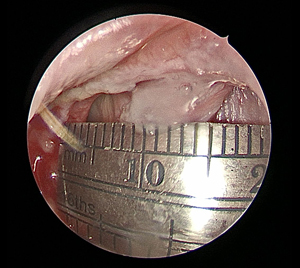
2. Size of Perforation
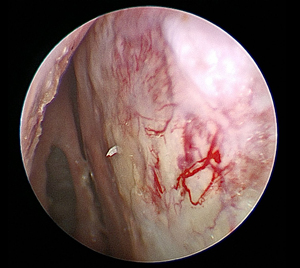
3. Healed result
What to Expect
- Evaluation: We use high-resolution endoscopy and CT imaging to map the size and location of the perforation.
- Surgery: Performed under general anesthesia, the procedure involves harvesting healthy tissue and meticulously closing the hole in layers. This is typically an outpatient procedure.
- Recovery: You will wear a splint for about a week to protect the repair. While the area heals, you must avoid heavy lifting and blowing your nose.
Patient Testimonial
“I was told by two other doctors that my hole was too big to fix and I’d just have to deal with the bleeding. Dr. Yeung fixed it using a graft from my leg. The whistling is gone, and I can finally breathe through my nose again.” – M.K., The Woodlands
Don’t accept “irreversible” as a diagnosis. Advanced reconstructive techniques can close your perforation and restore your quality of life.
Schedule a Perforation Evaluation Or call us
Other Procedures